

An angry customer with no receipt. A dented parcel for the fussiest customer on the street. In moments like these, your employees have no time to look things up. With role-play training, they’ve already had that conversation. Somewhere safe, before it counts.
What is role-play training?
In customer service role-play training, employees practise difficult conversations with an AI customer. That customer responds to what you say, just like a real one would. After every answer, you get instant feedback. What worked, and what could be better? In TinQwise NOW, it all happens on your phone, in a few minutes.
Emma and the customer with no receipt
It’s Emma’s first day. She’s learning the systems and finding her feet. Then an angry customer appears at the till. He wants to return something, but he has no receipt. There’s no colleague in sight.
Emma swallows. Then she stays calm. In the weeks before she started, she practised exactly this situation. She learned what the returns policy says. And, more importantly, how to explain it without the customer feeling brushed off.
“I understand this is frustrating,” she says. “Without a receipt, I’m afraid I can’t give you a refund. What I can do is...” She offers an alternative. The customer softens. He doesn’t get his money back. Still, he leaves the store without a trace of anger.

Jamie and the dented parcel
Jamie is a delivery driver. He knows which addresses he’d rather skip. Like Mrs Janssen’s, who spots every dent in a parcel. “When customers get angry, I don’t know what to say,” he tells his manager. “I either get defensive or I just keep apologising.”
His manager gets him practising. In the canteen, Jamie suddenly finds himself on a virtual doorstep. The AI customer snaps: “Where have you been? I’ve been waiting all day!” Jamie says what he always says: “I’m sorry. The routes were assigned late today.”
The scene pauses. “Good start with the apology,” says the system. “Can you also acknowledge how this feels for the customer?” Jamie tries again. He shows understanding, explains briefly and offers a solution. “Much better,” comes the reply.
Dozens of scenarios later, he’s standing at Mrs Janssen’s door. With a dented parcel. This time, he gets in first: “I noticed this parcel was damaged in transit. I’ve already reported it. Would you like to check the contents?” Mrs Janssen looks surprised. “Well, that’s a first.” Ten minutes later, she thanks him for his service.

Why role-play works
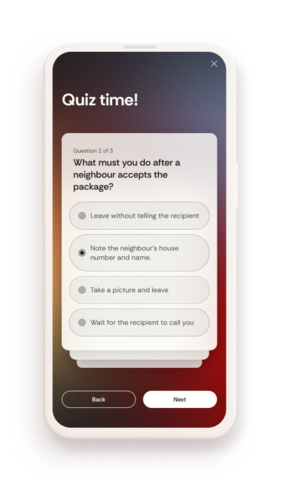
- Scenarios from real working life. The situations mirror what your team deals with every day. A return without a receipt. A neighbour taking in yet another parcel.
- A customer who responds. A good answer calms the AI customer down. A weak one leaves the frustration hanging. Just like in real life.
- Instant feedback. After every answer, you see what worked. Did you show understanding? Did you offer a solution?
- Safe to make mistakes. There’s no real customer in front of you. So a slip-up costs nothing.
- Harder, step by step. The better you get, the tougher the situations.
What it delivers
- For store managers: new employees who can handle a difficult customer on their own. You don’t have to step in as often.
- For L&D: insight into how employees perform in conversations. A ticked-off module tells you very little about that.
- For HR: one training for every store. Each employee practises at their own level.
Managers practise this way too. Read how Frank learned to have difficult conversations with his team.

